
Every great Arctic story starts with a paradox. Imagine a land frozen in colonial time. Britain kept it in 1814, thinking icy islands were less valuable than ruling the seas.
Then, Jonathan Motzfeldt emerged. He became Greenland’s first premier. His career started when Greenland was caught between being independent and Danish.
It’s like a teenager wanting freedom but needing money. Martin Breum’s insights show how Motzfeldt shaped Greenland’s identity.
This was when the Arctic changed from a frozen backwater to a global prize. It’s like Game of Thrones but with more ice and fewer dragons.
Home Rule and the Shift Toward Autonomy
Imagine getting your first apartment but your parents pay the utilities. That’s like Greenland’s Home Rule arrangement. It let Greenlanders manage their own affairs, but Denmark handled defense and foreign policy. It was like having driver’s license privileges while someone else owned the car.
Motzfeldt worked in a gray area where ambition met practical limits. He used Denmark’s oversight as a shield and weapon. When policies worked, he took credit for Greenland’s ingenuity. When they failed, he blamed the Danes.
Navigating Scandal: Public Reactions and Media Coverage
Every political leader faces a crisis that tests their character. Motzfeldt’s came from money, power, and questionable judgment.
The media showed Greenland’s political growth. Early reports were respectful, but as democracy grew, journalists asked tough questions. It was like watching a teenager develop critical thinking.
People reacted with shock, then a practical view of the scandal’s impact. They saw that personal failures didn’t always affect policy. In small communities, what matters is effectiveness, not perfection.
Motzfeldt and Arctic Climate Policy: A New Direction for Leadership
After the scandal, Motzfeldt focused on climate change. He saw the Arctic as key to climate change and geopolitics.
He turned Greenland into a climate change leader, not just a victim. Melting ice became a chance for new shipping routes and resources. It was like turning bankruptcy into an investment.
The table below shows how Motzfeldt’s leadership changed Greenland’s role in the Arctic:
| Period | Political Status | Climate Approach | International Standing |
|---|---|---|---|
| Pre-Home Rule | Danish Colony | Environmental Victim | Policy Recipient |
| Home Rule Era | Autonomous Region | Strategic Partner | Emerging Voice |
| Post-2009 | Self-Government | Policy Maker | Arctic Leader |
Motzfeldt’s shift in Arctic governance was his greatest skill. He turned weaknesses into strengths. By seeing Greenland as key to climate solutions, he got a seat at important tables.
The growth of Greenland politics under Motzfeldt shows how small nations can be big players. It’s a lesson in making geography a strength, not a weakness.
Sports, Culture, and Motzfeldt’s Community Initiatives
While politicians debated sovereignty, Motzfeldt saw something key. He knew national identity is built on hockey rinks and cultural festivals, not just in chambers. He made community centers a symbol of unity for Greenlanders.
Motzfeldt’s approach to Nordic sports context was genius. He didn’t just fund sports; he created cultural exchanges. This made Greenland an equal in Scandinavian affairs. Danish and Norwegian teams came to Nuuk for tournaments, building connections that mattered more than treaties.
Evaluating Political Legacy: Lessons for Today’s Policy Students
What makes Motzfeldt’s political legacy stand out today? He governed through cultural touchpoints, not just ideology. Unlike others, he focused on community infrastructure, improving daily life.
His strategy teaches three key lessons for policy students:
- Cultural capital outweighs political capital in the long run
- Local initiatives create stronger foundations than top-down policies
- Sports and culture provide neutral ground for difficult conversations
The table below contrasts traditional political approaches with Motzfeldt’s community-focused strategy:
| Traditional Approach | Motzfeldt’s Strategy | Community Impact |
|---|---|---|
| Top-down policy implementation | Grassroots cultural development | Higher engagement |
| Economic indicators as success metrics | Cultural participation rates | Tangible benefits |
| International diplomacy focus | Local facility investment | Immediate improvements |
| Theoretical sovereignty debates | Practical autonomy exercises | Visible progress |
Cultural Reflections: Greenland’s Evolving Identity Post-Motzfeldt
Greenland’s cultural evolution is a fascinating study. The nation balances modern dreams with Inuit traditions. Motzfeldt understood this delicate balance instinctively.
Today, Greenland shows Motzfeldt’s political legacy through its cultural mix. Artists blend traditional stories with digital media. Musicians mix ancient drum dances with electronic beats. This cultural renaissance grew from Motzfeldt’s community efforts.
The Nordic sports context remains key in this identity formation. International competitions showcase Greenland’s modernity and tradition. It’s nation-building through sports, as Motzfeldt envisioned.
His greatest insight? Cultural confidence comes before political confidence. By strengthening Greenland’s culture, he built a nation ready to stand on the world stage. Not as Denmark’s dependent, but as a unique Arctic civilization with its own voice and vision.
Tributes and International Responses to His Passing
When Jonathan Motzfeldt died in 2010, the world took notice. World leaders who didn’t know where Greenland was twenty years ago suddenly cared. Tributes came from capitals that once ignored Greenland.
Why did they suddenly care? Martin Breum’s “Cold Rush” explains it well. Greenland became a key player in the Arctic. Beijing to Brussels wanted to show off their Arctic influence.
The condolences from world leaders told a story. Denmark’s queen called him “a father of modern Greenland.” The EU Commission praised his “visionary leadership.” Even China’s embassy in Copenhagen spoke up, showing Greenland’s new importance.
Motzfeldt’s success was clear in these tributes. He didn’t just win home rule; he made the world notice Greenland. The tributes showed Greenland’s growing influence in global affairs.
The parliamentary record from that time shows the mourning at home. But the international responses showed more. They showed Motzfeldt had put Greenland at the heart of three big global talks:
- Climate change diplomacy – Everyone suddenly cared about melting ice
- Resource competition – The fight for Arctic minerals and energy
- Geopolitical positioning – The new game at the world’s top
Motzfeldt’s Jonathan Motzfeldt biography is more than local politics. It’s about how a leader from a small place made it big on the world map. The tributes showed he succeeded where others might have failed.
Today’s policy students should learn from these responses. They show how regional leaders can use global trends. Motzfeldt knew climate change and resource needs gave Greenland new chances. His death reminded the world of the impact small places can have with visionary leaders.
The ultimate test of a leader? When your death gets noticed in capitals that ignored you before. By this measure, Motzfeldt’s Jonathan Motzfeldt biography is a must-read in the history of great leaders.
Greenland’s Transformation: Motzfeldt’s Early Influence
Imagine Greenland in the 1970s. It was a cold, forgotten place where Denmark kept its old colonial ways. Polar bears were more common than politicians. Then, Jonathan Motzfeldt came along, changing everything.
Martin Breum’s “Cold Rush” shows how fast Greenland changed. It went from a forgotten land to a key player in the Arctic. Motzfeldt was the conductor of this change, leading it with skill.

Motzfeldt saw climate change as a chance, not just a problem. He believed melting ice could open up new paths for shipping and mining. This was his vision for Greenland’s future.
He was a true climate leader before the term was even coined. He knew Greenland’s icy cover was melting, revealing new opportunities.
Motzfeldt’s bold move was to make Greenland a major Arctic player. Despite being small, he played the global game with confidence. He was like a chess master, using every piece to his advantage.
His early work made Greenland a nation that took charge. It moved from being Denmark’s problem to a key player in the Arctic.
Motzfeldt’s way of leading was unique. He was practical, quick to seize opportunities, and fearless. He didn’t just face climate change; he harnessed it for Greenland’s benefit.
The key to climate leadership today is not just cutting emissions. It’s about finding chances in crises and changing the rules while others follow the old ones.
Motzfeldt’s vision turned Greenland into a global player. It’s not just politics; it’s about seeing the future in the melting ice and building something new from it.
Home Rule and the Shift Toward Autonomy
Imagine getting the keys to your own apartment but your parents paying the rent. That’s what Greenland’s Home Rule felt like. Jonathan Motzfeldt made this balance his art.
Martin Breum’s “Cold Rush” shows the tension. Greenland wanted freedom but needed Danish money. Motzfeldt balanced these needs.
The 1979 Home Rule Act was more than a law. It was a step towards freedom. Motzfeldt knew true freedom comes slowly. He focused on small wins to move Greenland towards self-rule.
Here’s what made Motzfeldt’s approach work:
- He saw autonomy as a journey, not a single event
- He kept talking to Danish officials
- He kept the economy stable while pushing for freedom
- He kept the public informed and involved
Motzfeldt’s patience was key. He didn’t just hand over powers. He grew them. Each success showed Greenland could handle more freedom.
This patience led to interesting changes in Arctic governance. Greenland took control of:
| Area of Control | Before Home Rule | After Home Rule | Motzfeldt’s Impact |
|---|---|---|---|
| Education System | Danish curriculum | Greenlandic-focused education | Cultural preservation |
| Resource Management | Danish oversight | Local decision-making | Economic development |
| Local Government | Appointed officials | Elected representatives | Democratic strengthening |
| Cultural Policies | Assimilation focus | Indigenous promotion | Identity building |
Motzfeldt’s way to freedom wasn’t about big speeches. It was about building strength slowly. He knew true freedom needs strong institutions.
The financial side was tricky. Danish money was about 60% of Greenland’s budget during Motzfeldt’s time. This created a paradox – Greenland wanted freedom but needed Danish money.
Motzfeldt turned this weakness into strength. He showed Denmark that Greenland could handle more freedom. Each step built trust that Greenland could manage more on its own.
Motzfeldt’s strategy is a lesson for others seeking freedom. He showed that slow, practical steps can be more effective than big speeches. His approach to Arctic governance is a model for self-determination.
The lesson for today’s leaders? True freedom is about building strength slowly. Motzfeldt’s Home Rule strategy shows that sometimes, the most revolutionary act is slow, steady progress.
Navigating Scandal: Public Reactions and Media Coverage
Imagine a political scandal in a place where everyone knows each other. That’s Greenland politics in a nutshell. Here, accountability meets intimacy in fascinating ways.
Motzfeldt’s career was a masterclass in damage control. Controversies played out like family dramas in parliament. The media coverage evolved, showing Greenland’s journey toward self-governance.
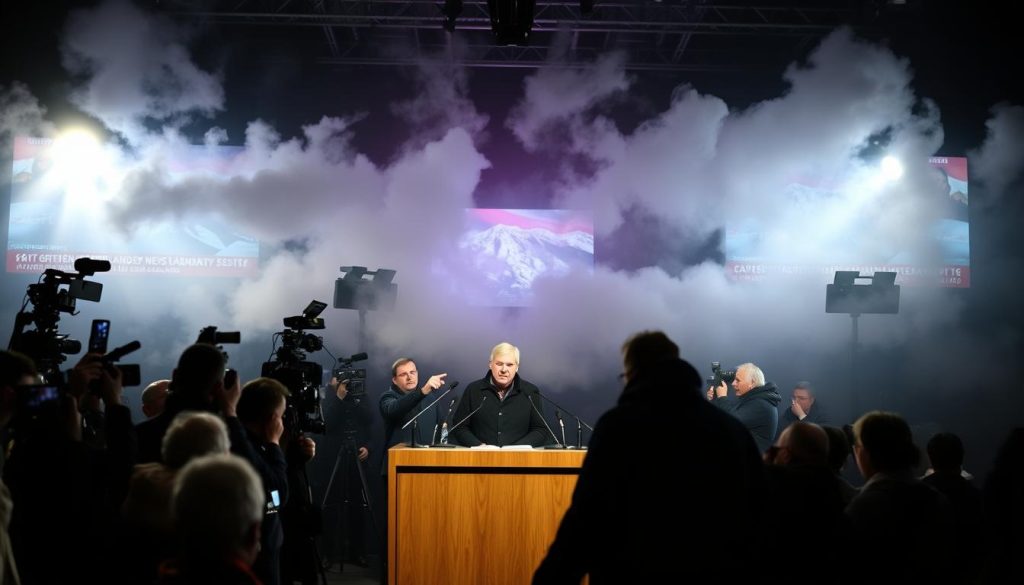
The 1990s budget controversy was a big deal. Local press covered it like concerned relatives. Nordic media outlets added a special Scandinavian touch.
Public reactions showed something deep about Greenlandic political culture. Instead of outrage, there were thoughtful discussions. It was accountability without annihilation – a rare political art form.
When Greenland’s media started treating scandals as systemic issues, it was a big change. This reflected the territory’s growth from dependent territory to self-governing society.
What can American observers learn from this approach? Maybe that political accountability doesn’t need to be a bloodsport. In Greenland politics, scandals were chances for growth, not destruction.
The media coverage balance here is delicate. It’s enough scrutiny for transparency, but also respect for governance stability. It’s a tightrope walk that would make most Western journalists dizzy.
Motzfeldt’s handling of controversies showed how leadership works in small societies. You can’t hide facts when everyone knows everyone. The game is about managing relationships while keeping principles.
This unique approach to Greenland politics offers fascinating insights for political students everywhere. Sometimes the most advanced political cultures aren’t the largest. They’re just the most thoughtfully managed.
Motzfeldt and Arctic Climate Policy: A New Direction for Leadership
While the world feared melting ice caps, Jonathan Motzfeldt saw a chance. He focused on Greenland’s resources, not just saving polar bears. He knew that in politics, every crisis is a chance to grow.
Martin Breum’s “Cold Rush” analysis highlights Motzfeldt’s bold move. He opened up new shipping routes and access to resources. Suddenly, the Arctic became a key player on the global stage. Motzfeldt’s approach was not just about saving the environment, but about gaining power.
Motzfeldt’s leadership changed Greenland’s image. Instead of worrying about rising seas, he saw a chance to grow. He used the melting ice as a strategic advantage, playing a long game.
Motzfeldt’s story teaches us to look beyond the disaster to the opportunity. In a world where solutions are melting away, we need his vision. It’s about finding chance in every crisis.